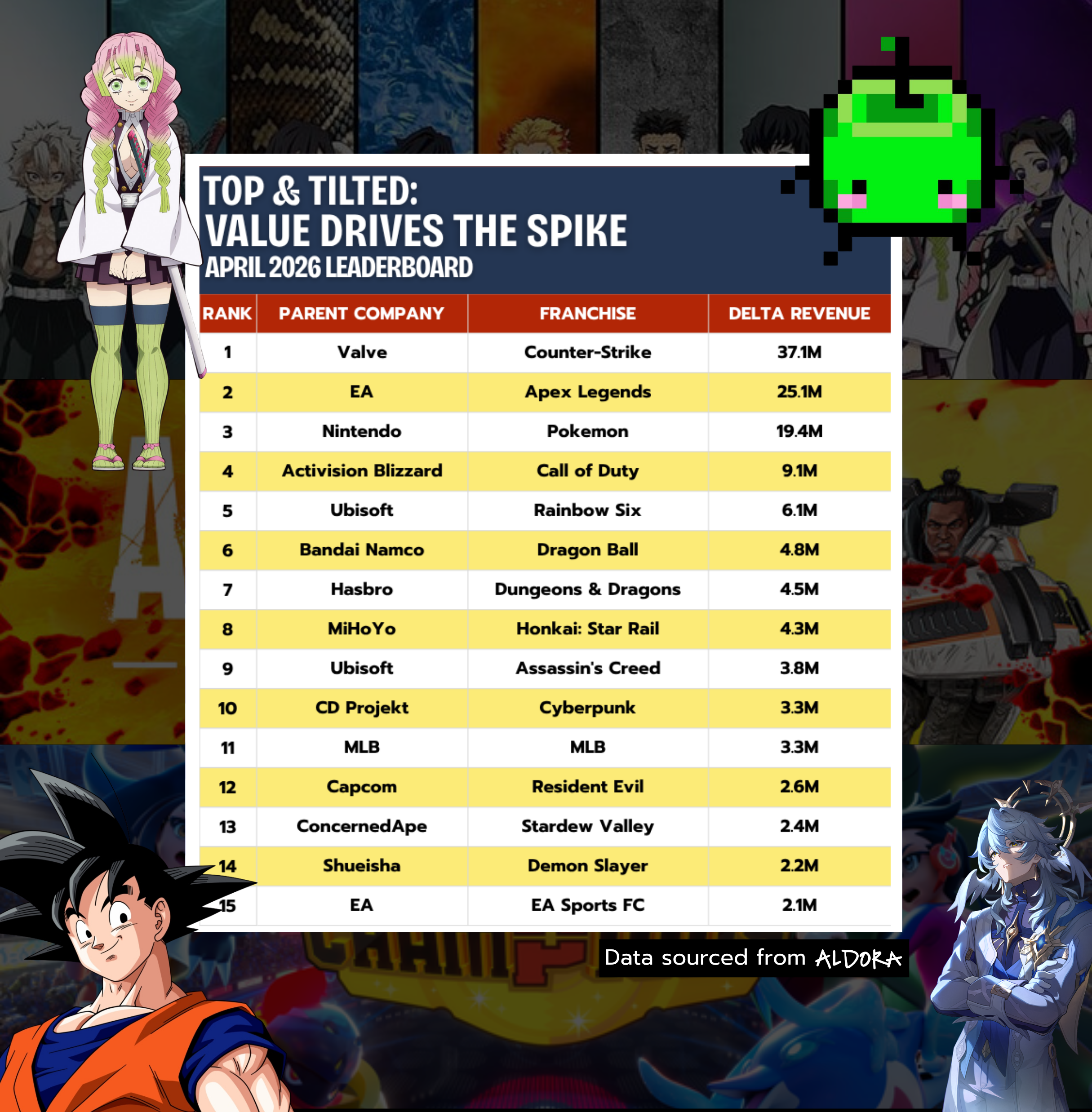
Scale creates the surface area. Value drives the spike. From Valve’s Counter-Strike (#1, +$37.1M) to EA’s EA Sports FC (#15, +$2.1M), this month’s ALDORA leaderboard shows a consistent pattern: revenue increases concentrate around moments that give players a reason to spend.
ALDORA tracks monthly revenue across mobile, Steam, and box office channels. Delta revenue reflects the month-over-month change in revenue, capturing incremental growth rather than total revenue.
Execution Over Scale
At the top of the leaderboard, execution, not just audience size, drives outcomes. Nintendo’s Pokémon (#3, +$19.4M) and Activision Blizzard’s Call of Duty (#4, +$9.1M) both benefited from strong engagement cycles that drove players to spend.
The same pattern holds at #1. Counter-Strike didn’t lead on scale alone. It benefited from a clear reactivation moment that translated directly into revenue. Meanwhile, Apex Legends (#2) shows how consistent update cadence can sustain monetization over time.
Revenue Is a Function of Cadence
Further down the leaderboard, cadence remains a key driver. Ubisoft appears twice with Rainbow Six (#5, +$6.1M) and Assassin’s Creed (#9, +$3.8M), reflecting ongoing live activity on Steam. While not indicative of broader company performance, both franchises show how consistent updates can still generate incremental revenue gains.
Bandai Namco Entertainment’s Dragon Ball (#6, +$4.8M) and Hasbro’s Dungeons & Dragons (#7, +$4.5M) reflect structured content strategies, but their placement also highlights how effectively that engagement translates into measurable spending.
CD Projekt’s Cyberpunk (#10, +$3.3M) saw a lift aligned with broader distribution changes, while MLB (#11, +$3.3M) benefited from seasonal timing. These are clear inflection points that drove spending and leaderboard movement.
Different Paths, Same Outcome
The rest of the leaderboard highlights how diverse revenue drivers can be. Capcom’s Resident Evil (#12, +$2.6M) leveraged its 30th anniversary, while Stardew Valley (#13, +$2.4M) continues to benefit from momentum carried over from its 10th anniversary celebrations in February, compounding through ongoing updates and sustained community engagement. Shueisha’s Demon Slayer (#14, +$2.2M) and Electronic Arts’ EA Sports FC (#15, +$2.1M) round out the list, showing that even smaller revenue gains are tied to deliberate product and content decisions.
The winners are those who convert attention into spending. The ALDORA leaderboard captures those moments in real time.
ALDORA tracks brand performance across five dimensions of the gaming ecosystem—Play (direct gameplay), Watch (streaming and video content), Connect (social interactions), Create (user-generated content), and Spend (in-game purchases and merchandise)—linking engagement signals directly to revenue outcomes.
KEY INSIGHTS
1. Scale ≠ Revenue
Counter-Strike (#1, +$37.1M) and Apex Legends (#2, +$25.1M) didn’t lead because they’re big; they led because they gave players a reason to spend. Scale created the opportunity. Value—and execution—drove the outcome.
2. Cadence Drives Monetization
From Call of Duty (#4, +$9.1M) to Rainbow Six (#5, +$6.1M), spikes in revenue growth are tied to updates, seasonal drops, and structured content roadmaps. Cadence isn’t just a retention tool; it’s a monetization strategy. Publishers who ship on a rhythm give players a recurring reason to spend.
3. Revenue Is Event-Driven
From Cyberpunk (#10, +$3.3M) to MLB (#11, +$3.3M), revenue growth clusters around key moments. These are inflection points. The franchises that plan for them capture the spend; the rest miss it.
Analysis by ALDORA CEO Joost van Dreunen
Contact
ALDORA
🌐 www.aldora.io
📍 Brooklyn, NY